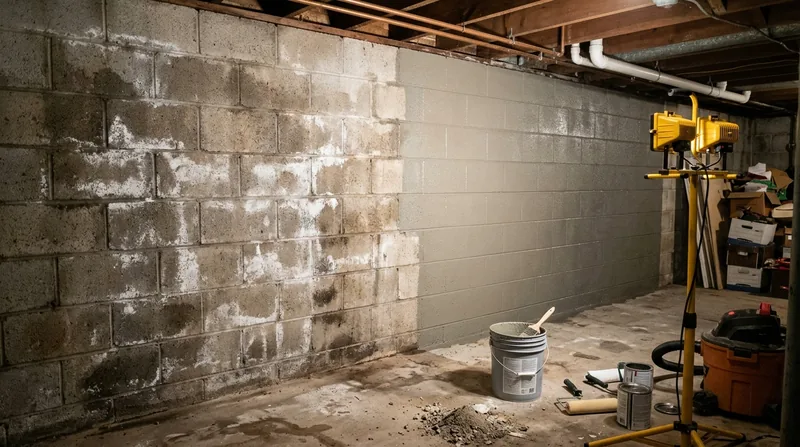




If you own one of the older brick bungalows near Campus Corner or Andrews Park with a block or early poured basement wall, you already know what a wet spring does to masonry. Basement Wall Sealing in Norman is the straightforward answer for walls that weep, chalk, or bloom with white salt stains, but only when the water is surface dampness and not hydrostatic pressure pushing through the wall. Norman sits on red clay and shale that swells hard after a May or June thunderstorm and shrinks in a dry August, and that movement opens the fine cracks and porous mortar joints where dampness starts. We prep the wall, strip the efflorescence, and apply the right penetrating or membrane sealer for what your wall is actually doing. If the diagnosis points to a drainage problem instead, we say so before you spend a dollar on sealer. Start with a free basement inspection and we will tell you which problem you have.
Why Basement Wall Sealing Matters on Norman's Red Clay and Shale
Most Norman homes are slab-on-grade, and basements are rare here, so the houses that do have one tend to be the 1920s to 1950s bungalows near the university and a scattering of 1960s split-levels on the east side. Those below-grade walls are block or early poured concrete, often with original parging that has chalked away over decades. When the clay soil around the footing stays saturated after a storm, moisture wicks through the wall and shows up as efflorescence, a musty basement smell, or paint that blisters and peels off in sheets.
- Sealing stops surface dampness and slows the carbonation that eats away at old mortar joints.
- Sealing does not stop water that is being pushed in by hydrostatic pressure, and pretending otherwise wastes your money.
- Efflorescence removal has to happen before any sealer goes on, or the coating traps salts and fails within a season.
- Hairline cracks wider than a credit card usually need foundation crack repair before sealing, not after.
We look at the wall, the grading, and the downspout extensions before we recommend a product, because the honest answer is sometimes that sealer is not the fix.
Key info: A homeowner on a 1948 brick bungalow off Lindsay Street had white bloom across the whole north wall every spring. The wall was damp, not leaking, and a penetrating sealer after efflorescence removal solved it. A house two blocks over had the same bloom plus a wet floor line, and that one needed interior drainage, not sealer.
Permits for below-grade work vary by jurisdiction, and the City of Norman building department is the authority to check with before any structural repair or drainage alteration. You can review their permit information at normanok.gov.
How We Seal a Basement Wall in Norman, Step by Step
We do not roll sealer onto a dirty wall and call it done. The prep work is most of the job, and it is what separates a coating that lasts from one that peels off by the next wet season. Here is the sequence we run on a typical Norman basement.
- We inspect the wall for active seepage, crack width, and bowing, and we check the floor line for water coming up rather than through.
- We remove efflorescence and loose parging with a wire brush and a masonry cleaner, then let the wall dry to a measured moisture level.
- We inject any structural crack with epoxy or polyurethane before sealing, because sealer over a moving crack will just crack again.
- We apply the sealer, either a penetrating silicate that bonds into the masonry or a membrane coating for block walls that need a film.
- We correct the grading and downspout extensions at the same visit so runoff off the street and roof stops soaking the same wall.
After the job, we walk the wall with you and show you what to watch for, including any spot where the sealer is a bandage and drainage is the real cure.
Key info: On a 1972 split-level in east Norman, the wall looked damp but the real issue was a failed footing drain sending water back against the wall. Sealing alone would have trapped moisture. We sealed the dry sections and routed the wet run to an interior drain tile system.
Sealing Approaches We Use and When Each One Fits
Not every Norman wall wants the same product. Block walls wick differently than poured walls, and a wall with active seepage needs a different answer than one that is simply damp to the touch. The table below shows how we match the approach to the wall.
| Approach | Description | Best for |
|---|---|---|
| Penetrating silicate sealer | Bonds into the masonry pores and blocks capillary wicking without a surface film. | Damp poured walls with no active seepage |
| Membrane coating | Flexible film that bridges hairline movement and covers porous block faces. | Block walls with chalky mortar and minor seepage |
| Crack injection plus sealer | Epoxy or polyurethane injection closes the crack, then sealer protects the surrounding wall. | Walls with a defined leaking crack |
| Drainage-first assessment | We test for hydrostatic pressure and route you to drainage if sealer will not hold. | Wet floor lines and water after every big rain |
Basement Wall Sealing Cost in Norman: What to Expect
Most single-wall sealing jobs in Norman start around $1,500, and that figure covers prep, efflorescence removal, and the sealer itself on a standard basement wall. The number climbs with wall length, how much parging has to be rebuilt, and whether a crack needs injection first. A wall that needs drainage work is a different scope entirely, and we will tell you that up front rather than sell you a coating that cannot hold.
Access matters too. A basement wall crowded by mechanicals or shelving takes longer to prep, and old block that crumbles under the wire brush needs patching before sealing. We give you a written scope so you can compare our number against another bid line by line. See the full pricing overview for how the ranges break down, and always get two or three estimates before you commit.
Choosing a Basement Wall Sealing Contractor Near Me in Norman
Anybody with a roller and a bucket can call themselves a waterproofing contractor, so the vetting matters more than the sales pitch. Ask for the license and insurance certificate, ask how they diagnose pressure versus dampness, and ask what they do when sealer is not the right answer. A contractor who only sells coatings will always find a reason to sell you one.
- Confirm the company is licensed and insured, and ask to see the certificate before work starts.
- Get two or three written estimates with the same scope so you are comparing like for like.
- Ask for local references from Norman basements, not just out-of-town jobs.
- Check permit requirements with the City of Norman building department for any structural or drainage work.
- Understand your HOA rules if you live in one of the newer south or west side subdivisions.
When you are ready, contact us and we will schedule a look at your wall and give you a straight answer.
Basement Wall Sealing in Norman: Pricing Guide
| Service | Price | Details |
|---|---|---|
| Single wall sealing | Starting at $1,500 | Includes prep, efflorescence removal, and one penetrating or membrane sealer on a standard wall |
| Full basement perimeter sealing | Starting at $2,800 | Covers all walls, with price moving up on wall length and how much parging needs rebuilding |
| Crack injection plus sealing | Starting at $1,900 | Epoxy or polyurethane injection on a defined crack before the sealer goes on the wall |
| Drainage-first assessment | On estimate | When hydrostatic pressure is the cause, we scope drainage instead of selling a coating |
| Travel | Included | In Norman and surrounding areas, no separate call-out or mileage fee |
| Estimate | Free | Response within 24h at (405) 561-3307, no obligation to book |
Indicative pricing, the exact cost depends on square footage, finish, and site access. Free personalized estimate within 24h at (405) 561-3307.


