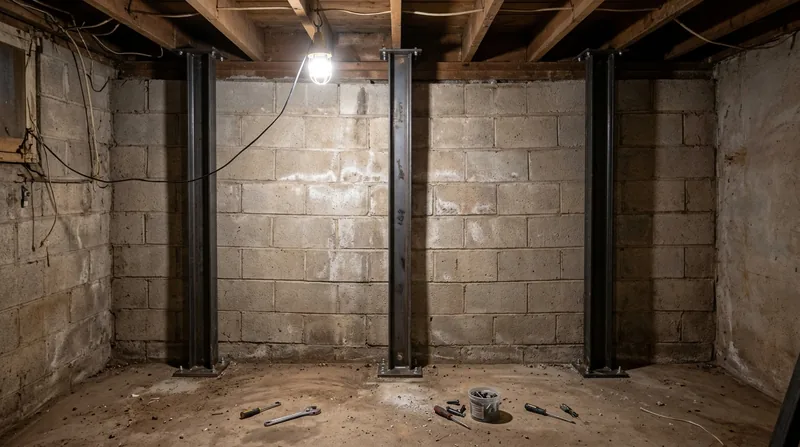




Norman sits on red clay and shale that swells hard after a wet spring and shrinks back in a dry August, and that cycle pushes sideways against block and early poured walls in the older bungalows around Campus Corner and Andrews Park. If you own one of those homes and the wall is leaning in, Bowing Wall Repair in Norman is the work that stops the movement before the floor joists start to follow. Most of Norman is slab-on-grade, so we say it plainly: true basements are rare here, and when we find one it is usually a 1920s to 1950s block wall that has been taking clay pressure for decades. We stabilize the wall with carbon fiber straps, steel I-beams, or wall anchors matched to how far it has moved and what the soil is doing. Call (405) 561-3307 and we will tell you honestly whether you need structural work or just crack sealing.
Movement does not fix itself and it does not slow down on its own once hydrostatic pressure has found a path. Read our foundation crack repair page if the wall is cracked but still plumb, because that is a different job with a different price.
Why Bowing Walls Show Up in Norman's Older Block Foundations
The clay under Norman expands when the May and June storms soak it and contracts through the dry summer, and every one of those cycles loads the outside face of an old block wall. Add flash runoff running off the streets toward foundations and the water table rising after a big rain, and you get the horizontal cracks and inward lean we see on the east side and around the older core. Homes built from the 1960s through the 1980s sit mostly on slab with grade beams, so the bowing we repair is concentrated in the pre-1960 block basements and the occasional early poured wall.
- You see a horizontal crack along the middle of the wall, often with efflorescence staining where water has been pushing through.
- The top or bottom of the wall has kicked inward and the floor above feels springy or out of level.
- Doors and windows on that side of the house stick in humid weather and free up when it dries out.
- Water shows up on the basement floor after storms, which tells us the wall is loaded and the drainage has failed.
Any one of those signs is worth a look, and two or more together means the wall is moving now, not ten years from now.
Key info: A 1948 block bungalow near Andrews Park came in with a 2-inch lean at the top of the north wall after the 2023 spring storms. The clay had been pushing since the drain tile clogged, and the wall anchors went in only after we restored drainage.
For the official word on structural permits in this city, check the City of Norman building department before any structural work starts, because rules vary and must be verified.
How We Stabilize a Bowing Wall in Norman, Step by Step
We start by finding out what is actually pushing the wall, because a strap on a wall that is still taking water is a bandage. We read the crack pattern, check the soil and grading outside, and confirm whether the footing drain is working. Then we match the repair to the severity: carbon fiber straps for a wall that has moved less than about 2 inches, steel I-beams for heavier loads, and wall anchors when the clay outside is the main culprit. If the wall is wet, we fix the drainage first through an interior drain tile system so the repair is not fighting hydrostatic pressure.
- We inspect the wall inside and out, measure the lean, and map the cracks before quoting anything.
- We correct the water source first, whether that means grading, a downspout extension, or drain tile repair.
- We install carbon fiber straps, steel I-beams, or wall anchors on the specified spacing and embedment.
- We seal the crack faces and parge where the wall needs it, then verify the wall is stable before we leave.
The order matters, and skipping the drainage step is why some repairs fail within a couple of seasons.
Key info: A split-level in Moore had a wall leaning 1.5 inches and a sump pump that had quit the previous summer. We restored the discharge line, added a battery backup, and strapped the wall. Same clay, same fix pattern.
Matching the Repair Method to the Movement
Not every bowing wall gets the same hardware, and the table below shows how we decide. The right answer depends on how far the wall has moved, how tall it is, and whether the load is coming from clay pressure or from a failing footing.
| Approach | Description | Best for |
|---|---|---|
| Carbon fiber straps | Woven straps epoxied vertically to the inside face and anchored top and bottom. | Block walls that have moved less than about 2 inches. |
| Steel I-beams | Beams set against the wall and tied into the floor and joists above. | Taller walls and heavier movement where straps are not enough. |
| Wall anchors | Plates outside in the soil tied to brackets inside through the wall. | Walls pushed by swelling clay where the soil can be reached. |
| Crack sealing and injection | Epoxy or polyurethane injection into the crack after the wall is stable. | Cracks that are not yet moving, as a first step. |
We choose the method on site, not over the phone, because the lean and the soil tell us which one will hold.
Bowing Wall Repair Cost in Norman: What to Expect
Pricing for bowing wall work starts at $600 for a smaller, contained repair and climbs from there with the length of wall involved and the method. Carbon fiber straps on a short run are on the lower end, while steel I-beams or full wall anchors on a long wall are the higher end because of the hardware and the time in the ground. Access matters too: a wall behind a finished basement or tight against a neighboring lot takes longer than an open one. Get two or three estimates and compare the method, not just the number, because a cheap strap on a wall that needs anchors will not hold.
Our full pricing overview lays out the ranges by method so you can see where your wall falls before anyone visits.
Choosing a Bowing Wall Repair Contractor Near Me in Norman
Ask for the license and the insurance certificate before anyone touches your foundation, and confirm the policy covers structural work, not just general labor. Get at least two written estimates that name the method and the hardware, and ask for references from jobs in Norman or Moore so you can see the same clay and the same block walls. Confirm who pulls the structural permit, because the city building department requires one for foundation repair and the rules vary. If you are in an HOA, check the exterior work rules before anchor plates go into the yard.
When you are ready to talk it through, contact us for a free estimate and we will tell you what the wall needs.
Bowing Wall Repair Near Me: What Norman Homeowners Should Know
If you are searching for bowing wall repair near me in Norman, the first thing to understand is that the wall does not straighten itself and the movement rarely stops without intervention. We see the same pattern across the older core and out into Noble and Lexington: a clogged footing drain, a wet spring, and a wall that leans a little more each year. Catching it at half an inch is far cheaper than catching it at two inches, and that is the honest reason to call early. Reach us at (405) 561-3307 and we will schedule an inspection before the next round of storms.
Bowing Wall Repair in Norman: Pricing Guide
| Service | Price | Details |
|---|---|---|
| Carbon fiber strap repair | Starting at $600 | Short wall run, straps epoxied and anchored, wall movement under 2 inches. |
| Steel I-beam stabilization | Starting at $1,800 | Taller or longer walls, beams tied to floor and joists, hardware included. |
| Wall anchor system | Starting at $2,400 | Exterior plates and interior brackets, priced by wall length and soil access. |
| Drainage correction first | On estimate | Drain tile repair or grading needed before structural work can hold. |
| Travel | Included | In Norman and surrounding areas, no separate call-out or mileage fee. |
| Estimate | Free | Response within 24h at (405) 561-3307, no obligation to book. |
Indicative pricing, the exact cost depends on square footage, finish, and site access. Free personalized estimate within 24h at (405) 561-3307.


