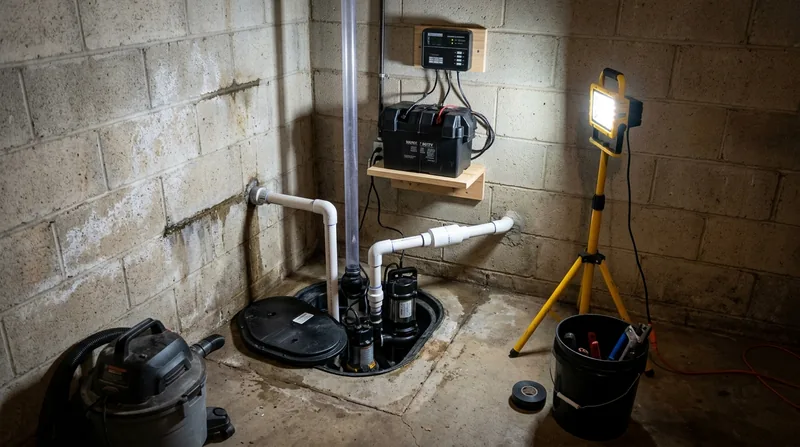




Norman sits on red clay and shale that swell hard in a wet May and shrink back in a dry August, and that ground movement is what pushes water at your foundation in the first place. Most Norman homes are slab-on-grade, so when we talk about a sump pump here we are usually talking about a pit cut into an interior drain tile system, a window well drain, or a low spot at a walkout, not a full basement. A Battery Backup Sump Pumps in Norman setup keeps that pump running when the same spring storm that dumps two inches in an hour also takes the grid down on your block. Power and water fail together here, and that is the whole reason a backup exists. We size the battery to your actual pit depth and pump draw, not to a generic box on a shelf. Start with a free basement inspection and we will tell you straight whether you need one.
Why a Backup Matters More in Norman Than Most Homeowners Think
The failure mode that dominates in Norman is not a pump that wears out, it is a pump that loses power in the middle of the one storm that matters. The May and June thunderstorm season sends flash runoff off the streets toward foundations across the east side and the older blocks near Andrews Park, and Imhoff Creek and the Little River push their banks after the big rains. A primary sump pump on grid power is only as reliable as the line feeding it.
- A backup pump runs on a charged battery when the power goes out, so the pit keeps emptying during the storm.
- It buys you hours of pumping when the primary pump jams on grit or trips a breaker.
- An alarm sounds before the water reaches the floor, not after.
- It protects the interior drain tile system you already paid for by keeping the basin from overflowing.
- It covers the 1920s bungalows and 1960s ranches where the pit sits low and the water table rises fast.
None of that is guesswork, it is the difference between a wet floor and a dry one on the same night.
Key info: A homeowner near Campus Corner called after a June storm knocked out power for six hours. The primary pump quit, the basin filled, and water crossed the slab into a finished room. A backup with a fresh battery would have kept that pit dry the whole night.
For the underlying drainage design, the local building department and the State of Oklahoma resources are the places to verify current rules before any work is permitted.
How We Install a Backup System in a Norman Home
We start by looking at what you already have: pit size, pump brand, discharge line routing, check valve condition, and whether the basin is fed by an interior perimeter drain or a single window well drain. Then we match the battery and charger to the actual pump draw so the backup is not undersized on the night it runs. The whole job is usually a half day in a typical Norman pit.
- We inspect the pit and confirm the primary pump, float, and check valve are working before we add anything.
- We mount the backup pump and float switch so the two pumps do not fight each other.
- We set the battery box and charger on a shelf or stand clear of the floor and any seepage.
- We tie the backup into the existing discharge line with a dedicated check valve.
- We test both pumps under load, then walk you through the alarm and the maintenance schedule.
Every install ends with a live test, not a handshake.
Key info: In a 1970s split-level off Alameda, the pit sat under a low soffit and the discharge line ran tight to the joist. We used a compact backup pump and a sealed AGM battery to fit the space, then tested it with the primary unplugged to prove it would carry the load alone.
If the primary pump itself is old or undersized, pairing the backup with a sump pump installation or replacement is the smarter order of work.
Backup Pump Options We Install
Not every Norman pit needs the same hardware. A shallow basin in a 1950s bungalow near Andrews Park and a deep pit in a newer west-side subdivision call for different battery capacity and different float logic. Here is how the common approaches compare.
| Approach | Description | Best for |
|---|---|---|
| Battery backup pump and charger | A second pump in the same pit on a charged battery with an automatic charger. | Most Norman homes with an existing sump basin. |
| Combination primary and backup unit | One housing with a main pump and a battery-driven pump side by side. | Tight pits where two separate pumps will not fit. |
| High-capacity AGM battery set | Larger battery bank for longer runtime during extended outages. | Homes that lose power for hours in storm season. |
| Alarm and float upgrade | High-water alarm and a reliable float switch added to the existing setup. | Homeowners who want warning before the floor gets wet. |
| Discharge and check valve rework | New discharge routing and check valves so both pumps move water cleanly. | Older pits with a shared or failing discharge line. |
We pick the option that fits your pit and your outage history, not the biggest box on the shelf.
Battery Backup Sump Pumps Cost in Norman: What to Expect
A basic battery backup install starts around $900 in the Norman market, and that figure covers a backup pump, a battery and charger, the check valve, and the labor to tie it into your existing pit. Where it climbs is battery capacity, pit access, discharge rework, and whether the primary pump needs replacing at the same time. A tight pit under a low soffit takes longer than an open one, and a high-capacity AGM set costs more than a standard battery.
Get two or three estimates and compare what is actually included, not just the bottom line. A quote that skips the check valve or the battery is not the same job. Our full breakdown lives on the pricing page, and we will put the number in writing before we start.
Choosing a Waterproofing Contractor Near Me in Norman
Ask three things before anyone touches your pit: are you licensed and insured, what exactly is in the quote, and can I talk to a recent customer in Norman. A backup pump is a small job with a big consequence if it is wired wrong or the battery is undersized, so the contractor matters as much as the hardware. Confirm whether the discharge routing or any drainage change needs a permit from the local building department, since thresholds vary and the rules must be verified for your address. If you are in an HOA, check the exterior discharge rules before the install day.
Reach out through the contact page and we will set up a time to look at your pit. For homeowners in the 73071 zip, the 73071 battery backup page covers the local details.
Battery Backup Sump Pumps in Norman: Pricing Guide
| Service | Price | Details |
|---|---|---|
| Basic battery backup install | Starting at $900 | Includes backup pump, battery, charger, check valve, and labor in an existing pit. |
| Combination primary and backup unit | Starting at $1,250 | One housing with both pumps, best for tight pits where two units will not fit. |
| High-capacity AGM battery set | Starting at $1,450 | Larger battery bank for longer runtime during extended storm-season outages. |
| Alarm and float upgrade only | Starting at $350 | High-water alarm and new float switch added to your existing pump setup. |
| Discharge and check valve rework | On estimate | Needs an on-site look at routing, joist clearance, and existing line condition. |
| Estimate | Free | Response within 24h at (405) 561-3307, no obligation to book. |
Indicative pricing, the exact cost depends on square footage, finish, and site access. Free personalized estimate within 24h at (405) 561-3307.


