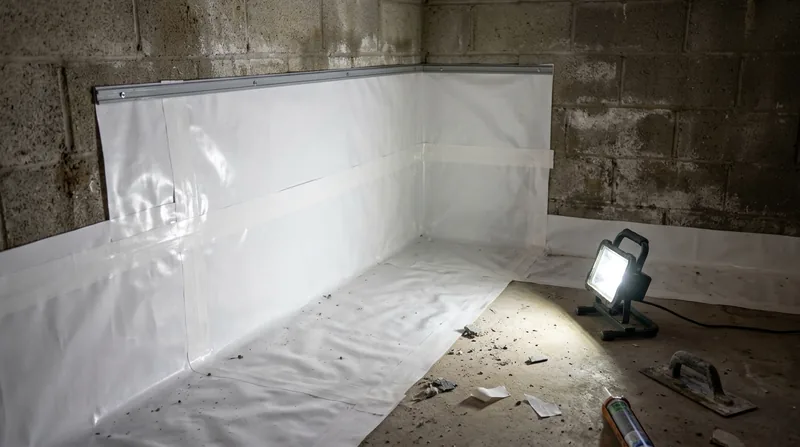




Vapor Barrier Installation in Norman: Stop Ground Moisture Before It Reaches Your Walls
If you own one of the older brick or frame bungalows near Campus Corner or Andrews Park, or a 1960s ranch on the east side with a block or early poured basement, you already know that Norman sits on red clay and shale soils that swell when wet and shrink hard in a dry August. That cycle pushes moisture vapor through the slab and wall pores long before you see a puddle. Vapor Barrier Installation in Norman is the below-grade step that blocks that vapor at the source, with heavy-duty sheets sealed at every seam and taped at every termination. We install it across basement walls and slab, tie it into the sump basin where one exists, and leave you with a drier lower level instead of that recurring damp smell after a May thunderstorm. For the full picture of how this fits with drainage and wall sealing, see our basement waterproofing service.
Why Norman Basements Sweat: Clay Soil, Flash Runoff, and Vapor Drive
Norman gets most of its rain in heavy May and June thunderstorms, and the water does not soak in evenly. It sheets off the streets, runs along the grade, and pushes against foundations while the clay above is still saturated. Imhoff Creek and the Little River flood their banks after big rains, and the water table rises with them. That is hydrostatic pressure, and it drives moisture vapor through concrete and block even when the wall looks dry. Add hot, humid summers and the wide open prairie sun, and you get the classic Norman pattern: efflorescence on the lower block, a musty smell in July, and slab edges that crack as the clay shrinks back.
- We see vapor drive most often in the 1920s to 1950s bungalows with partial basements of block or early poured walls.
- We also find it in 1960s to 1980s split-levels where the lower level sits partly below grade against swelling clay.
- And we correct it in newer south and west side subdivisions where slab-on-grade construction traps ground moisture under the finished floor.
A vapor barrier does not replace drainage, but it closes the path that moisture uses to reach the interior surface. Where the real problem is active water, we say so and point you to drain tile first.
Key info: A homeowner in the 73069 area near Andrews Park had efflorescence climbing two feet up a block wall and a musty smell every June. The wall was not leaking. Moisture vapor was moving through the block from saturated clay outside. A sealed vapor barrier on the wall and slab, tied to a sump basin, dried the surface within weeks.
For the code side, the City of Norman Building Department handles permits for work that alters drainage or structural elements, and rules vary by jurisdiction. Verify the current requirements at the City of Norman official site before any work begins.
How We Install a Vapor Barrier in a Norman Basement
We start with a free basement inspection, because a vapor barrier is the wrong answer when there is standing water or an active crack leaking under pressure. Once we confirm the source is vapor and not a failed footing drain, we plan the sheet layout around your sump basin, window wells, and any penetrations. The work is clean and sequenced, and we do not leave an open excavation overnight.
- We inspect the walls and slab for efflorescence, active seepage, and crack patterns, and we test whether the moisture is vapor or liquid.
- We cut and fit heavy-duty vapor barrier sheets to the wall height and slab dimensions, with a continuous overlap at the wall-floor joint.
- We seal every seam and tape every termination, and we integrate the sheet into the sump basin so water that does collect goes to the pump, not the floor.
- We check the discharge line and check valve if a sump pump is present, and we flag a failing pump before we close up.
If your lower level also needs drainage correction, we coordinate the barrier with an interior drain tile system so the two systems work as one.
Key info: On a 1970s split-level off Alameda Street, the lower wall read damp every spring but never dripped. We installed a sealed wall and slab barrier with a taped wall-floor joint and tied it to the existing sump basin. The musty smell cleared, and the homeowner stopped running a dehumidifier around the clock.
Vapor Barrier Approaches We Use in Norman Homes
Not every basement needs the same sheet or the same coverage. The table below shows the approaches we specify most often in Norman and the surrounding towns, and what each one is actually for.
| Approach | Description | Best for |
|---|---|---|
| Wall and slab sheet barrier | Heavy-duty sheets run continuously from the wall plate down across the slab, with sealed seams and a taped wall-floor joint. | Full basements with vapor drive on both surfaces |
| Wall-only barrier over block | Sheet applied to the interior face of block or poured walls, terminated at the cove joint and sealed at the top. | Efflorescence and damp block with a dry slab |
| Dimple board drainage mat | Drainage mat against the wall that lets water drop to the drain tile while the barrier blocks vapor. | Walls with minor seepage plus vapor, paired with interior drain |
| Sump-integrated barrier | Barrier sheet lapped into the sump basin with a sealed collar so any collected water reaches the pump. | Basements with an existing sump pump or planned installation |
| Penetration and window well sealing | Taped terminations around pipes, window wells, and egress openings so the barrier stays continuous. | Finished basements with egress windows or utility penetrations |
We choose the approach after the inspection, not before, and we tell you plainly when a simple wall seal is enough.
Vapor Barrier Installation Cost in Norman: What to Expect
Most Norman vapor barrier work starts at From $3/sq ft for a standard wall and slab sheet installation with sealed seams and taped terminations. That figure is a starting point, not a flat quote. The number moves with square footage, wall height, the number of penetrations, whether the slab needs prep, and whether the barrier ties into a sump basin. A small wall-only job on a Campus Corner bungalow prices differently from a full lower-level barrier in a 1990s west side subdivision.
Access matters too. A basement with a finished ceiling, tight mechanical closets, or a window well that needs resealing takes longer than an open, unfinished space. If we find active seepage during the inspection, the honest answer may be that drain tile comes first, and we will tell you that instead of selling a barrier over a water problem. Get two or three estimates and compare scope, not just the bottom line. Our full pricing overview shows how the line items break down.
Hiring a Vapor Barrier Installation Contractor Near Me in Norman
When you search for vapor barrier installation near me in Norman, the list looks long, but the questions that separate contractors are simple. Ask for the license and insurance certificate, not just a verbal yes. Ask what the scope covers at the seams, the wall-floor joint, and the sump collar, because those are where cheap jobs fail. Ask for local references, especially from homeowners in older Norman neighborhoods with block walls. And ask who pulls the permit if the work touches drainage or structural elements, since the City of Norman Building Department sets the threshold and it varies by jurisdiction.
- Confirm the contractor is licensed and insured, and request a certificate before work starts.
- Get at least two or three written estimates with the same scope so you can compare fairly.
- Check references from Norman, Moore, and Noble homeowners with similar foundation types.
- Ask about permits and any HOA requirements before the crew mobilizes.
Reach out through our contact page to schedule a free inspection and get a written scope for your basement.
Vapor Barrier Installation Near Me: What Norman Homeowners Should Know
Timing matters in this climate. The best window for vapor barrier work in Norman is late summer into early fall, after the clay has dried and before the next round of heavy spring storms. That is when the foundation is stable and the inspection can separate old moisture stains from active vapor drive. The dominant failure mode here is not a single cracked pipe or a leaking window. It is clay soil movement opening the wall-floor joint and slab edge, letting ground vapor rise into the lower level all summer.
If you are in Moore, Noble, Lexington, Purcell, or Newcastle, the same red clay and shale behavior applies, and we serve those towns with the same sealed-sheet method. We do not promise a lifetime warranty, only a transferable warranty on our work. Call (405) 561-3307 to book a free basement inspection and find out whether a barrier, a drain, or a simple crack seal is the right next step.
Vapor Barrier Installation in Norman: Pricing Guide
| Service | Price | Details |
|---|---|---|
| Wall-only vapor barrier | Starting at $3/sq ft | Includes surface prep, heavy-duty sheet, sealed seams, and taped terminations on block or poured walls |
| Wall and slab barrier | Starting at $4/sq ft | Adds continuous slab coverage and a sealed wall-floor joint for full lower-level vapor control |
| Sump-integrated barrier | Starting at $5/sq ft | Includes sealed collar at the sump basin and check of the discharge line and check valve |
| Complex or large-scale job | On estimate | Finished ceilings, multiple penetrations, window wells, or active seepage need an on-site look first |
| Travel | Included | In Norman and surrounding areas, no separate call-out or mileage fee |
| Estimate | Free | Response within 24h at (405) 561-3307, no obligation to book |
Indicative pricing, the exact cost depends on square footage, finish, and site access. Free personalized estimate within 24h at (405) 561-3307.


