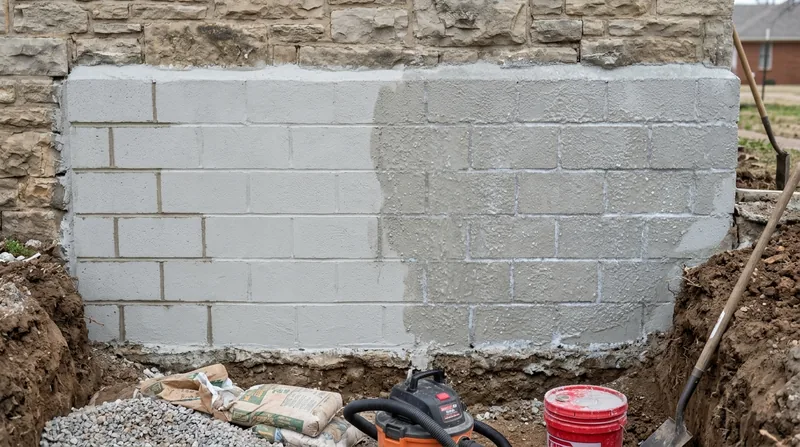




Foundation Waterproofing in Norman is not the same job it is in most of the country. Around Campus Corner and Andrews Park, the 1920s and 1950s brick and frame bungalows that still have a basement sit behind block or early poured walls, and those walls take on water differently than a modern wall. Across the central and east side, the 1960s to 1980s brick ranches and split-levels are mostly slab-on-grade with grade beams, so the water problem shows up at the slab edge and the footing, not in a basement you can walk into. South and west of town, the 1990s to 2020s subdivisions are almost all slab-on-grade too. We say that plainly because it changes the answer. The ground under all of it is red clay and shale that swells when wet and shrinks in a dry summer, and that movement is what opens the cracks and pulls the grade away from the house. If you have water coming in after a May or June storm, start with a free basement inspection so we can see what the wall and the footing drain are actually doing.
Why foundation waterproofing matters on Norman's red clay and shale
The dominant failure mode here is hydrostatic pressure against a wall that was never built for a saturated clay soil. Norman's clay holds water instead of draining it, so after a heavy spring storm the soil around the footing is heavy and pushing inward, and that pressure finds every cold joint, tie hole, and hairline crack in a block or poured wall. Imhoff Creek and the Little River go over their banks in big rains, and street runoff from the graded subdivisions on the south and west edges runs straight toward the foundation. Efflorescence on the inside face of a block wall is the tell: the white salt bloom means water is moving through the block, not just staining it.
- Block walls from pre-1940 homes wick water through the mortar joints and need parging plus a proper membrane or crystalline treatment, not a coat of paint.
- Poured walls from the 1960s and 1970s crack at the shrinkage joint and at the form tie holes, which is where epoxy or polyurethane injection earns its money.
- Slab-on-grade homes on grade beams show the problem as a wet slab edge, a musty smell, or a settled corner, and the fix is drainage and grade correction, not a basement wall coating.
- Homes near the creeks and low spots take on a rising water table, and no surface sealer holds back a water table under hydrostatic pressure.
We tell homeowners which of these they have before we quote anything, because a $600 crack injection and a $9,000 perimeter drain solve two different problems.
Key info: A 1950s block bungalow near Andrews Park with efflorescence on the north wall is a wicking problem, not a crack. A 1970s ranch off Alameda with one vertical crack leaking after rain is usually a single injection job. Same city, same clay, two different repairs.
For the official word on what needs a permit when structural repair or drainage work is involved, check the City of Norman building department at normanok.gov before work starts.
How we waterproof a Norman foundation, step by step
Every job starts with the wall, not with a product. We map the cracks, check the grade and the downspout extensions, look at the footing drain if it is accessible, and test whether the water is coming through the wall or up from under the slab. Only then do we pick the method. On a block wall we grind out and repoint the joints, parge the face, and apply a membrane or a crystalline coating that goes into the block rather than sitting on top of it. On a poured wall we inject the crack with epoxy or polyurethane and install injection ports at the right spacing. When the water is hydrostatic and the wall cannot be kept dry from the outside, we correct the drainage instead.
- We inspect the interior face, the exterior grade, and the footing drain, and we take moisture readings at the base of the wall.
- We correct the grading and extend the downspouts so roof and surface water leaves the foundation instead of soaking the clay beside it.
- We repair the crack by injection or repoint and parge the block, matched to the wall type and the age of the home.
- We apply the membrane or crystalline treatment and, where the pressure is real, install an interior perimeter drain that leads to a sump basin.
- We set the sump pump, check valve, and discharge line so the water leaves the house and does not freeze or recycle back to the wall.
If the wall is bowing rather than leaking, that is a structural repair and we refer it to the bowing wall repair side of the work before any coating goes on.
Key info: On a split-level in east Norman, the lower wall was wet only after storms that pushed Imhoff Creek up. The wall itself was sound. We ran an interior perimeter drain to a sump basin and left the wall alone. On a 1930s bungalow near Campus Corner, the block was wicking year-round and needed parging and a crystalline treatment instead.
Waterproofing methods we use, matched to the foundation
There is no single product that fixes every Norman foundation, and any contractor who says otherwise is selling a coating, not a repair. The table below is how we match the method to the wall and the water source.
| Approach | Description | Best for |
|---|---|---|
| Epoxy or polyurethane injection | Ports drilled along the crack, resin pumped in to fill it full depth | Active leaks in poured walls, single vertical or diagonal cracks |
| Parging and crystalline treatment | Joints ground and repointed, face parged, crystalline coating drawn into the block | Pre-1940 block walls with efflorescence and wicking |
| Exterior membrane and dimple board | Wall excavated, membrane applied, dimple board and drain tile set at the footing | Walls that can be dug out, where the water comes from the soil side |
| Interior perimeter drain and sump | Drain tile at the interior footing edge, leading to a sump basin and pump | Hydrostatic pressure and a rising water table, where excavation is not practical |
| Grade and downspout correction | Regrade the soil to slope away, extend downspouts and discharge lines | Slab-on-grade homes and any wall where surface water is the source |
We will tell you when a simple crack seal is enough and when the pressure behind the wall means a coating will fail by the next spring.
Foundation Waterproofing cost in Norman: what to expect
Most foundation waterproofing work in Norman starts around $3,500, and that figure covers a real repair, not a patch. A single poured-wall crack injection is at the low end of that range. A block wall that needs repointing, parging, and a crystalline treatment runs higher because of the labor. An interior perimeter drain with a sump basin and pump is a bigger job and lands well above the starting figure. The variables that move the number are the wall type, the linear footage, how much excavation is needed, whether the footing drain has to be replaced, and how tight the access is around the foundation.
We quote from what we find on site, not from a phone description, because a slab-on-grade ranch in Moore and a 1930s basement bungalow in Norman are not the same job even when the symptom looks alike. Get two or three estimates and compare what is actually included, especially the discharge line and the pump. Our full breakdown is on the pricing page.
Hiring a foundation waterproofing contractor near me in Norman
Ask three questions before you sign anything: are you licensed and insured, what exactly is in the scope, and who pulls the permit if one is required. Structural foundation repair and any work that alters drainage or the sanitary connection of a sump discharge commonly need a permit in this area, and the rules vary by jurisdiction, so confirm with the City of Norman building department rather than taking a contractor's word for it. Ask for references from jobs in Norman or Moore that are at least a year old, and ask whether the work came with a transferable warranty. A contractor who cannot name the wall type in your home before quoting is guessing.
Call Norman Waterproofing at (405) 561-3307 to set up the free inspection.
Foundation Waterproofing in Norman: Pricing Guide
| Service | Price | Details |
|---|---|---|
| Crack injection (poured wall) | Starting at $3,500 | Includes port drilling, epoxy or polyurethane injection, and cleanup for a single active crack |
| Block wall parging and treatment | Starting at $4,200 | Includes joint repointing, parging, and crystalline treatment; wall length and access move the price |
| Interior perimeter drain and sump | On estimate | Linear footage, footing drain condition, and pump choice all change the number |
| Exterior membrane and dimple board | On estimate | Excavation depth, access around the foundation, and disposal drive the cost |
| Travel | Included | in Norman and surrounding areas, no separate call-out or mileage fee |
| Estimate | Free | Response within 24h at (405) 561-3307, no obligation to book |
Indicative pricing, the exact cost depends on square footage, finish, and site access. Free personalized estimate within 24h at (405) 561-3307.


